
Sewer Smell in Your DFW Home? The Problem Is Usually Under the Slab

A sewer smell coming from one drain is usually a small problem. A sewer smell that seems to come from the floor, or moves from room to room, or gets worse when the air conditioning runs, is usually a different problem entirely.
That pattern points to sewer gas escaping through your slab, from a drain line that has cracked underneath it.
Before you spend anything on that possibility, rule out the cheap causes first. There are three, they’re common, and two of them you can fix yourself this afternoon.
Start with the free fixes
A dry P-trap. Every drain has a U-shaped bend holding a small plug of water that blocks gas from the sewer side. If a fixture goes unused for a few weeks, that water evaporates and the barrier is gone. Guest bathrooms, basement or garage floor drains, and utility sinks are the usual suspects, and in a Texas summer evaporation happens fast. Run water down every drain in the house, including ones you never use, and pour a cup or two into any floor drain. Wait a day.
A failed toilet wax ring. If the smell is strongest near one toilet, or you notice slight rocking when you sit down, the seal underneath may have failed. Cheap part, straightforward repair.
A vent problem. Your plumbing vents through the roof. If that vent is blocked by a nest, a leaf pack, or a critter, gas that should exit above the roofline finds another way out. Gurgling drains alongside the smell is the tell.
If you work through all three and the smell is still there, keep reading. And if a plumber wants to sell you a repair before ruling these out, that’s worth questioning.
Why the slab is the usual answer in DFW
If your house was built before the mid-1970s, the drain lines running under it are very likely cast iron. Two things then work against you at once.
The soil moves. DFW sits on expansive clay that swells when it rains and shrinks in drought. That cycle flexes the slab and everything cast in it. Cast iron is rigid. It doesn’t bend, so it cracks, usually at the joints, and once it cracks it stays cracked.
The pipe corrodes from the inside. Cast iron rusts from the interior wall outward, worst along the bottom where water sits. Over decades the metal thins until sections open up.
Both failures create the same result: an opening in a pipe encased in concrete under your living space. Wastewater seeps out and sewer gas seeps up, following the path of least resistance through slab penetrations, expansion joints, and hairline cracks in the concrete, then up through flooring, baseboards, and the gaps around tubs and toilets.
That’s why the smell doesn’t seem to come from any specific fixture. It isn’t coming from a fixture. It’s coming from the floor.
It also explains the air conditioning connection. A running HVAC system changes the pressure balance in a house, and a slightly negative pressure indoors pulls harder on anything below the slab. If the smell shows up or intensifies when the system kicks on, that’s a meaningful clue, not a coincidence.
The reason you stop noticing it and guests don’t
Sewer gas is mostly methane and carbon dioxide with a small amount of hydrogen sulfide, and hydrogen sulfide is what produces the rotten egg smell.
Two things about it are worth knowing.
First, your nose stops registering it. Olfactory fatigue sets in quickly with hydrogen sulfide, which is why the people who live in the house stop noticing while visitors comment the moment they walk in. If guests keep mentioning a smell you can no longer detect, believe the guests.
Second, at the low concentrations typical of a slab leak in a ventilated house, sewer gas is generally a nuisance rather than an acute danger, though headaches, nausea, and irritated eyes and throat are common complaints. The reason to act quickly isn’t usually the gas itself. It’s what the gas is telling you: a drain line under your foundation is open and leaking.
That leak is the real problem. Water escaping under a slab saturates the clay beneath it, and saturated clay swells and moves. In North Texas that’s the mechanism behind a meaningful share of foundation problems, and foundation repair costs considerably more than the plumbing repair that would have prevented it.
How the source actually gets found
Guessing is expensive. There are two established tests, and in Texas the first one is standard practice.
A hydrostatic test. A plumber plugs the drain system at the cleanout and fills it with water to slab level. If the water level holds, the under-slab lines are sound. If it drops, there’s a leak below the slab. This is the same test used during real estate transactions across DFW, and it answers the yes-or-no question quickly and cheaply.
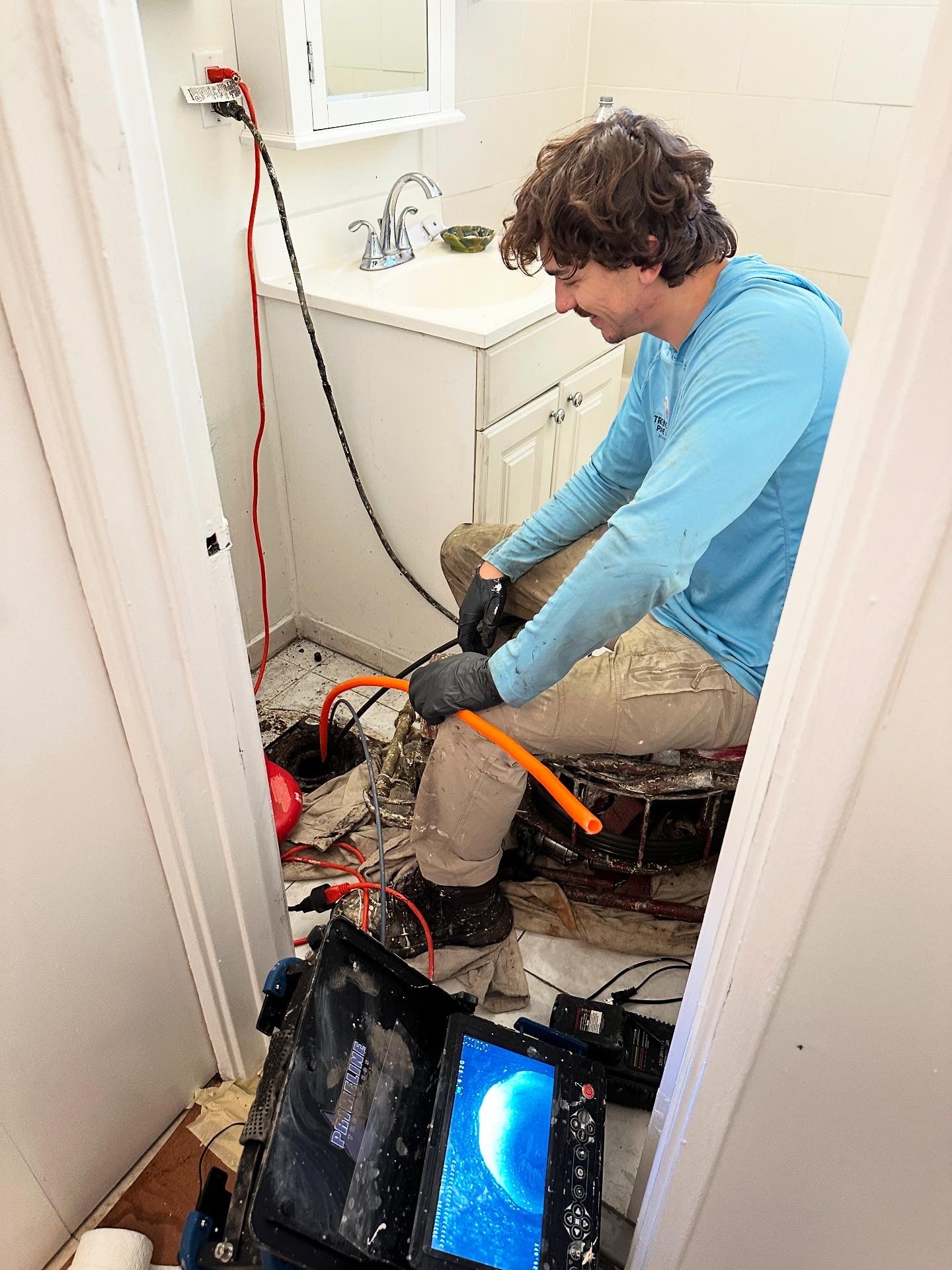
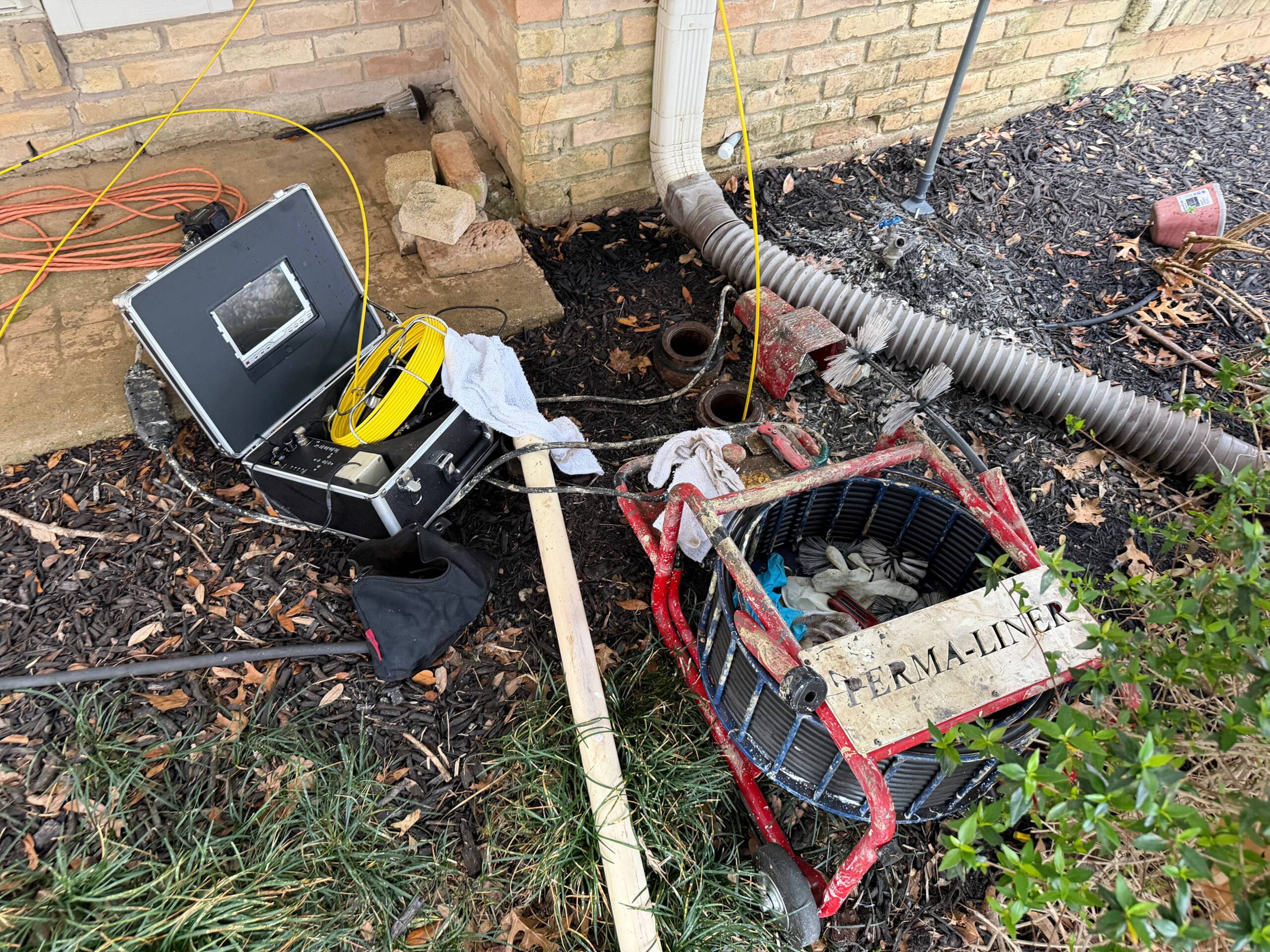
A camera inspection. Once a leak is confirmed, a camera goes into the line to find it. The footage should show a visible distance counter so you know how far down the line the defect sits, and the technician should be able to stand above ground and mark the location and depth on your floor. Without that, nobody can price the repair honestly.
Some plumbers also run a smoke test, pushing non-toxic smoke through the drain system and watching where it surfaces. It’s useful for finding openings and vent defects that a camera can miss.
Ask for the hydrostatic result and the camera footage before you agree to any repair. A leak under a slab is a serious finding, and serious findings come with documentation.
The fix, and why it doesn’t require breaking your floor
Once the failure is located, there are two ways forward.
Traditional replacement means getting to the pipe: either jackhammering through the floor inside the house, or tunneling underneath the foundation from outside. Both work. Both are disruptive, and in North Texas clay, excavating around a foundation carries its own risk. You also pay twice, once for plumbing and again for flooring and restoration.
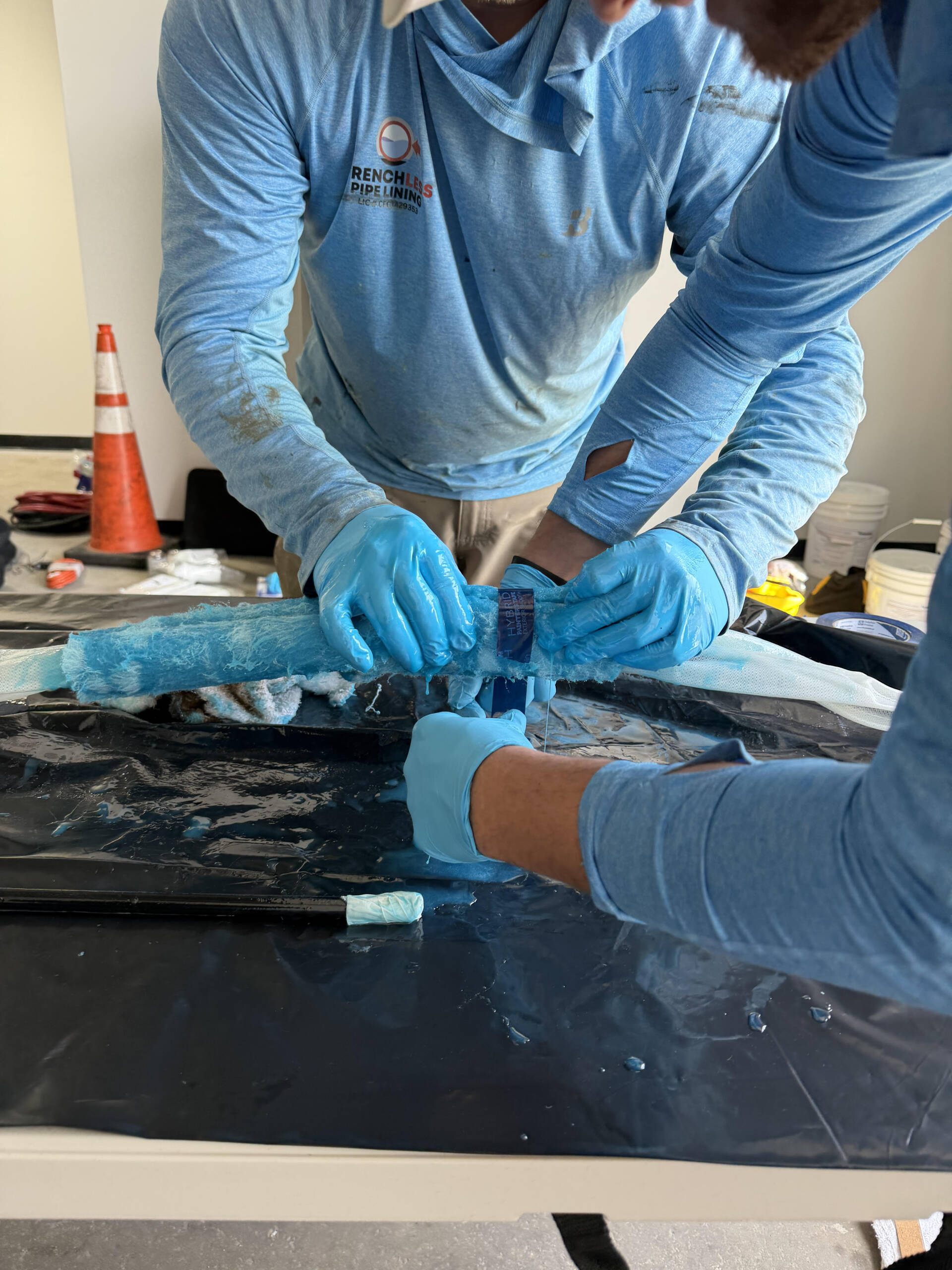
Trenchless lining restores the pipe from the inside, through existing access points. A resin-saturated liner is pulled into the cleaned pipe, inflated against the wall, and cured in place. What results is a seamless, jointless pipe inside the old cast iron, sealing the cracks and open joints along its length. Closing those openings removes the path the gas was using, which is exactly what the smell problem requires.
Cost in Dallas-Fort Worth: lining typically runs $10,000 to $20,000, against $40,000 to $50,000 for a full dig-and-replace. That’s a savings of 50 to 60%, and it’s priced per linear foot, verified by video-recorded distance at the end of the job. Our free camera-based estimate typically lands within 5% of final footage.
Most residential jobs finish in 3 to 5 days versus four to eight weeks for replacement, and around 95% of the work happens outside the house. Nothing is paid before work begins: 50% at start, 50% on completion. Financing runs from $1,000 to $200,000, with 0% APR for qualified applicants.
Honest caveat: lining restores the pipe wall, not the pipe’s slope. If a section has genuinely dropped and holds water, that section needs replacement, and we’ll say so at the inspection rather than after you’ve paid.
What to do this week
Run water down every drain in the house and give it a day. If the smell persists, get a hydrostatic test before anything else. It’s the fastest way to turn “something smells” into a definite answer, and it costs a fraction of what a wrong guess costs.
Schedule your free camera inspection and we’ll show you the footage, mark what we find, and give you a per-linear-foot estimate with no obligation. Call 469-949-3126. We return calls within 60 minutes and offer 24-hour emergency service. Sí, hablamos español.
Every liner we install carries a 50-year transferable warranty covering materials and labor, with free unlimited service calls and video inspections. The warranty term isn’t a slogan: an independent lab, HTS Materials Testing in Houston, samples our liner material three times a year and certifies a minimum 50-year engineered life against ASTM standards.
Trenchless Pipe Lining LLC · State-certified plumbing contractor · MasterRMP #37838 · BBB A+ accredited · Serving Dallas, Fort Worth, Arlington, Plano, Irving, Garland, Grand Prairie, McKinney, Frisco, Denton, Richardson, Lewisville, Mesquite, Carrollton, Allen, Flower Mound, North Richland Hills, Bedford, Mansfield, Euless, Keller, Southlake, Wylie, Coppell, Grapevine, and Austin.
We keep over 1,000 references with names and phone numbers, and we send them with your estimate so you can call them. That list includes work for the U.S. Navy, the U.S. Air Force, Coca-Cola, Pepsi, and the Hilton hotel chain.
Frequently Asked Questions
Why does my house smell like sewer but no drain smells?
Because the gas usually isn’t coming from a drain. When a drain line under the slab cracks, gas escapes through the concrete and up through flooring, so the smell seems to come from the floor or to move between rooms rather than from any one fixture.
Why is the sewer smell worse when the air conditioning is running?
A running HVAC system can put the interior of a house under slightly negative pressure, which pulls harder on air below the slab. If the smell appears or worsens when the system cycles on, that points toward a source under the foundation.
Is sewer gas in a house dangerous?
At the low concentrations typical of a slab leak in a ventilated home it’s generally a nuisance rather than an acute hazard, though headaches, nausea, and eye or throat irritation are common. The bigger concern is what it indicates: an open, leaking drain line under your foundation.
Why can’t I smell it anymore when guests still can?
Hydrogen sulfide causes olfactory fatigue, so your nose stops registering it after continued exposure. Visitors walking in fresh will notice immediately. If guests keep mentioning it, take it seriously.
What is a hydrostatic test?
A plumber plugs the drain system at the cleanout and fills it with water to slab level. If the level holds, the under-slab lines are sound. If it drops, there’s a leak below the slab. It’s standard practice in Texas and the fastest way to confirm or rule out an under-slab failure.
Can a cracked pipe under the slab be fixed without breaking the floor?
In most cases, yes. Trenchless lining restores the pipe from the inside through existing access points, sealing cracks and open joints without excavation. The exception is a section that has genuinely lost its slope, which needs replacement.
How much does it cost to fix a cracked sewer pipe under a slab in DFW?
Trenchless lining typically runs $10,000 to $20,000, compared with $40,000 to $50,000 for a full dig-and-replace. Pricing is per linear foot and verified on video at completion.
Can a leaking pipe under my slab cause foundation problems?
It can. Water escaping under a slab saturates expansive clay, and saturated clay swells and moves. In North Texas that’s a recognized contributor to foundation movement, which is why an under-slab leak is worth resolving quickly.
A great way to reach us!