
How Failing Cast Iron Pipes Can Damage Your DFW Home’s Foundation (And What to Do Before It’s Too Late)

The Warning Signs You’re Seeing May Not Be a Foundation Problem At All
If you’re a DFW homeowner watching new cracks appear in your drywall, feeling doors that suddenly stick, or noticing spots in your floor that weren’t level last year, your first call is probably to a foundation company. That makes sense. North Texas has some of the most expansive clay soil in the country, and soil-driven foundation movement is the single most common cause of residential foundation damage in this region.
But there’s a second cause of foundation damage in DFW that gets diagnosed less often, comes with a much smaller repair bill if caught early, and if missed, guarantees the foundation problem comes back a few years after you pay to fix it.
That cause is failing cast iron sewer pipes under your slab. This guide walks through how the connection works, how to tell whether it applies to your home, and why the sequence in which you address these problems dramatically affects how much you spend.
The Short Answer
Cast iron sewer pipes under North Texas homes crack along the bottom as they corrode. Water leaks out into the surrounding clay soil, which absorbs the moisture and expands unevenly. That uneven expansion pushes the slab from underneath, causing the same foundation heaving, wall cracks, and sticking doors that dry-shrink soil movement causes.
The critical difference: if you address the foundation without addressing the pipe, the leak keeps saturating the same zone of soil. The foundation moves again. You end up paying for foundation repair twice, sometimes three times, over 10 years.
Addressing the cast iron pipe first (typically with trenchless pipe lining, since the pipe runs under the slab) stops the leak, lets the soil rebalance, and in many cases resolves the foundation symptom without requiring a full pier job at all. When piers are still needed after the pipe is fixed, they hold because the underlying cycle has been broken.
How North Texas Clay Soil Turns a Small Pipe Leak Into a Foundation Problem
Most of DFW sits on the Blackland Prairie, one of the most expansive clay soil regions in the United States. The clay in this region is rich in smectite minerals that physically absorb water into their crystal structure. When wet, the clay swells. When dry, it shrinks. Research from the Texas A&M AgriLife Extension Service, the state’s authoritative agricultural research agency, has documented that most residential foundation movement in Texas is directly attributable to volume changes in the soil driven by moisture content. USDA Natural Resources Conservation Service soil surveys classify the majority of the DFW area as having moderate to high shrink-swell potential.
Under normal conditions, that expansion and contraction is uneven across your yard, driven by rainfall patterns, drought, and the shade cast by trees or the house itself. That’s why routine foundation maintenance is part of North Texas home ownership.
What most homeowners don’t realize is that a cracked pipe under the slab creates a localized zone of saturated soil that behaves nothing like the rest of the yard. Water leaks out slowly, continuously, and always in the same spot. That zone stays swollen even in drought conditions. The rest of the soil shrinks and expands normally around it. The result is a slab that’s being pushed up in one specific location, or held up while surrounding areas drop, which produces the exact same symptoms as classic expansive-soil damage: cracks, sticking doors, and uneven floors.
The mechanism is documented in the foundation industry, though the connection is often overlooked. Foundation contractors focused on the Texas market have noted that under-slab plumbing leaks are a significant and often overlooked cause of foundation movement across the state. The reason it gets missed is straightforward: foundation contractors are trained to look at the foundation, and plumbers are trained to look at the pipes. Almost nobody in either industry is trained to think about the connection between the two.
The Cost Cycle Homeowners Get Trapped In
Here’s the pattern that quietly plays out across DFW every year:
Year 1
Homeowner notices a crack in drywall, sticking doors, and an uneven floor. Foundation company diagnoses the issue as soil-driven and installs 6 to 10 piers. Cost: $10,000 to $20,000. Home is level again.
Years 2-3
The pipe under the slab is still leaking. The saturated soil zone is still growing. The piers hold the slab in place at the pier locations, but the pipe leak eventually creates enough pressure to shift the slab between pier locations or push up the sections that aren’t pinned by piers.
Years 4-5
New cracks appear. Doors start sticking again. Homeowner calls the foundation company. More piers get installed. Cost: another $8,000 to $15,000.
Years 6-8
Sewer line finally fails catastrophically. Sewage backup in the home. Homeowner calls a plumber. Plumber quotes traditional excavation of the entire under-slab system, which now involves breaking through the newly-installed piers as well as the slab itself. Cost: $50,000 to $80,000 including foundation restoration.
Total spent by Year 8: approximately $70,000 to $115,000
Now the alternate sequence:
Year 1 (Alternate)
Homeowner notices the same symptoms. Contractor identifies the under-slab cast iron pipe as the root cause via video camera inspection. Pipe is repaired with trenchless lining. Cost: $17,000 to $20,000.
Years 1-2 (Alternate)
The saturated soil zone gradually rebalances. Foundation symptoms often improve without further work. If piers are still needed, they hold because the underlying leak is gone. Cost of piers if required: $10,000 to $15,000.
Total spent by Year 8 (Alternate): $17,000 to $35,000. Foundation problem does not recur.
The difference between these two sequences is between $35,000 and $80,000 over the same eight years. For a broader look at how trenchless lining changes the economics of cast iron repair for DFW homeowners, see our related analysis of whether trenchless sewer repair is worth it.
Warning Signs That Suggest Pipes Are the Root Cause
Some foundation problems in DFW are pure soil movement. Others are pipe-driven. Here are the differentiators.
Signs that suggest pipes are the root cause:
- Foundation symptoms are concentrated in one specific part of the house rather than distributed across the perimeter
- Cracks or floor issues are near bathrooms, kitchens, or laundry rooms where drain pipes concentrate
- You’ve noticed slow drains, recurring backups, or sewage smells in the same area
- A specific spot in your yard is consistently soft or unusually green (especially if it lines up with where the sewer line runs out of the house)
- The home was built before 1980 (when cast iron was the standard drain material)
- Foundation symptoms don’t correlate strongly with weather (they persist even after wet or dry seasons)
Signs that suggest classical soil movement without a plumbing driver:
- Foundation symptoms are distributed around the perimeter of the house rather than in one zone
- Symptoms worsen dramatically during drought and improve during wet periods (or vice versa)
- No drain complaints, no unusual wet or soft soil spots
- The neighborhood shows similar patterns across multiple houses
- The home is a newer build (post-1985) that would typically have PVC drain pipes, not cast iron
Both patterns can also be present simultaneously. The foundation is stressed by classical soil movement AND compounded by a pipe leak. In those cases, the cost math still favors addressing the pipe first, then the foundation, because pipe-driven soil movement is what undermines pier work over time. For a broader look at plumbing-related symptoms, see our guide to the 10 warning signs you need trenchless sewer repair in Dallas, Fort Worth & Austin.
What the Diagnostic Process Should Look Like
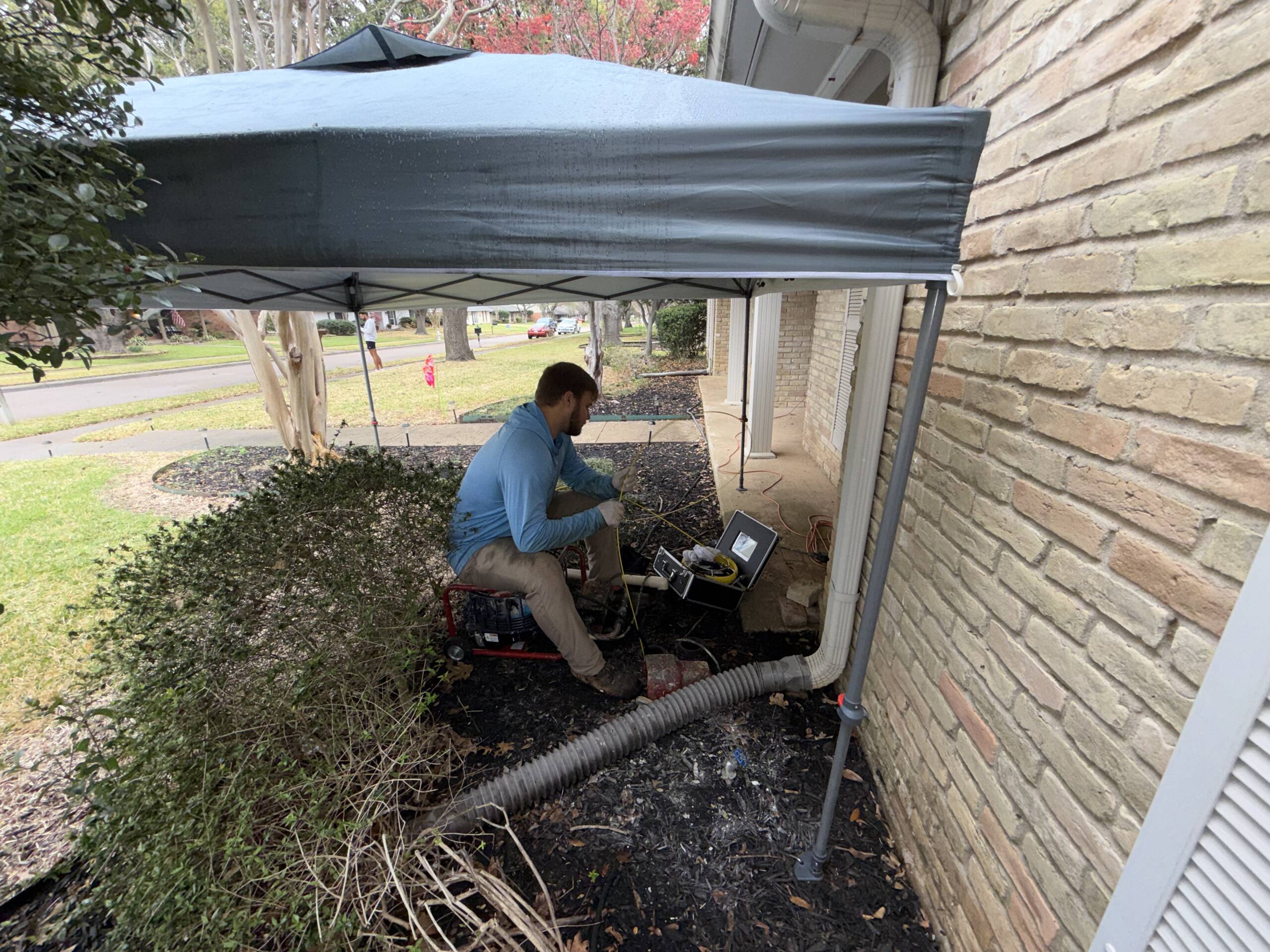
The right first step, if you’re seeing warning signs and your home is pre-1980, is a video sewer camera inspection. A waterproof camera goes through your sewer line via an existing cleanout, and the technician walks you through what they’re seeing in real time. Cast iron in late-stage failure shows visible cracks, missing sections, or corrosion channels. Camera inspection is typically the least expensive step in the entire diagnostic sequence.
If the camera inspection shows late-stage cast iron failure, the diagnostic pathway is clear: address the pipe first with trenchless lining, then reassess the foundation situation. If the camera shows the pipes are sound, then the foundation problem is soil-only, and pier work is the right call.
If the camera inspection is inconclusive, or if the pipe is failing in multiple ways, the sequence should still be pipes first. The pipe drives the water into the soil. Fix the water source, then let the soil rebalance, then decide about piers.
Why Trenchless Is the Right Fix at This Stage
Traditional excavation to replace the pipes involves opening the slab, removing large sections of flooring, digging up the pipe run, replacing with PVC, and restoring everything. In the middle of a foundation problem, this is the worst possible sequence. You’re opening the slab in the exact area where the soil has already been compromised, dramatically increasing the risk of further movement during the work itself. It also takes 4 to 6 weeks, during which the home is largely uninhabitable.
Trenchless pipe lining installs a new structural liner inside the existing pipe through the existing cleanouts. No excavation. No slab disruption. No flooring damage. Typical job completes in 3 to 5 days, and the home stays occupied throughout. The pipe leak stops the moment the lining cures.
For DFW homes on slab foundations that are showing foundation symptoms driven by pipe leaks, this is the fix that stops the mechanism without adding stress to an already-compromised soil zone. It’s also why trenchless has become the default sequence for pipe repair before foundation work in North Texas. For more on how the trenchless process works on cast iron under DFW slabs, see our detailed guide on trenchless pipe repair for cast iron sewer lines under slabs in Dallas-Fort Worth.
When the Foundation Is Beyond the Point Where Pipes-First Helps
To be honest, there are situations where the foundation damage has progressed far enough that piers need to be installed regardless of what’s happening with the pipes. If your foundation has settled significantly, if there are large structural cracks (not just cosmetic drywall cracks), if doors or windows are visibly out of square, or if a structural engineer has evaluated the home and recommended immediate piers, the foundation work needs to happen.
Even in those cases, the pipe question doesn’t go away. The piers stabilize the foundation, but if the pipe leak keeps saturating the soil, the same forces that caused the initial damage will keep working against the piers. Homeowners who install piers without addressing the pipe are more likely to see additional piers needed later, or to see continued cosmetic damage to interior finishes.
The right sequence in this scenario is still pipes and foundation together, not either one alone. Ideally: pipes fixed first, foundation shortly after, with the pier contractor informed of the pipe repair for proper planning.
What to Do If You’ve Already Had Foundation Work
A significant number of DFW homeowners reading this piece have already paid for pier installation and are seeing new symptoms return 2 to 5 years later. If that’s you, the sequence to follow is:
- Get a video sewer camera inspection to determine whether cast iron is the underlying issue.
- If the pipes are failing, address them with trenchless lining. This stops the mechanism that was undermining the pier work.
- If the piers themselves have moved or new zones have shifted, the foundation contractor may need to add piers or adjust the existing ones. Do this only after the pipe is fixed, because otherwise the same forces will undermine the new work.
- Document the pipe repair for insurance, appraisal, and future resale. The trenchless work comes with a 50-year transferable materials and labor warranty that adds real value on the resale side.
Frequently Asked Questions
Will my insurance cover cast iron pipe repair related to foundation damage?
This varies significantly by policy and carrier. Some policies cover the pipe damage itself; some cover the resulting foundation damage; some cover neither if the pipe failure is deemed “wear and tear” rather than a covered peril. See our related discussion of whether insurance covers trenchless sewer repair for the general framework. Regardless of coverage, documented trenchless repair with a transferable warranty is typically the strongest position from an insurance and future-claims perspective.
How do I know if my foundation contractor considered the plumbing question?
Ask directly: “Was a video sewer camera inspection performed as part of your diagnostic process?” If the answer is no, the foundation diagnosis is incomplete for any pre-1980 DFW home. A responsible foundation contractor working on an older home should be asking about the pipes, or should tell you why they don’t need to.
Does trenchless work under my slab if there’s already foundation damage?
Yes. Trenchless lining installs through cleanouts, not through excavation. The condition of the slab or foundation above doesn’t affect whether lining is technically possible. The pipe just needs to have a continuous pathway for the liner to travel through.
What if my home was built after 1985?
Post-1985 DFW homes almost universally have PVC drain pipes, not cast iron. PVC has different failure modes (typically joint separation from soil movement rather than corrosion) and different repair paths. If you’re seeing foundation symptoms in a post-1985 home, the pipe-connection issue is less likely, but a camera inspection is still cheap and definitive.
How much does the diagnostic camera inspection cost?
Typically a fraction of the cost of any repair option, and often free as part of an estimate. It’s the highest-value diagnostic step you can take when foundation symptoms are showing up in an older DFW home.
What if the foundation company also does plumbing?
Some general home services companies do both. The concern isn’t necessarily competency but incentive. If a company only offers pier work and doesn’t offer trenchless lining, they have no incentive to identify the pipe as the root cause. If a company offers both, ask specifically what they’d recommend and why, and get a second opinion regardless.
Should I address the pipe before or after selling the house?
If you’re planning to sell, address the pipe first, ideally 30 to 60 days before listing. Documented trenchless repair with a 50-year transferable warranty removes what would otherwise be a significant buyer concern and can support a higher sale price. Selling without addressing known pipe issues creates disclosure obligations and typically results in a larger price reduction than the cost of the repair itself.
Get a Camera Inspection Before the Next Repair Estimate
If you’re seeing warning signs and you’ve been told they’re foundation-only, get a video sewer camera inspection before signing anything. It’s the cheapest single step in the entire process and it determines whether you’re looking at a $20,000 repair or an $80,000 repair cycle.
Call 469-949-3126 or request a free estimate. We serve DFW homeowners with camera inspections, cast iron pipe lining, and honest diagnostic sequencing. 50-year transferable warranty. No pressure to add work that isn’t needed.
A great way to reach us!