
Does Your DFW Home Have Cast Iron Sewer Pipes? How to Tell by Age

How to Know If Your Home Has Aging Cast Iron Pipes
If your home was built before 1980, there’s a real chance your sewer line is cast iron – and a real chance it’s quietly nearing the end of its working life.
Cast iron was the dominant material for residential drain-waste-vent piping in the U.S. from the early 1900s until the mid-1970s, when PVC began replacing it. In the Dallas–Fort Worth area specifically, most homes built before 1980 have cast iron drain piping. And with cast iron’s typical service life running 50–75 years, much of that piping is reaching the end of its working life all at roughly the same time.
The clearest way to know whether your home is at risk isn’t by neighborhood – it’s by year built. Some neighborhoods have higher concentrations of at-risk homes than others, but newer construction exists inside even the oldest neighborhoods, and the only way to know for certain what’s under your slab is a video sewer camera inspection.
The Short Answer: Cast Iron Risk by Home Age
This is the simplest way to gauge your risk, and it applies to homes anywhere in the Dallas–Fort Worth Metroplex:
Comparison table: CIPP vs Spin Cast Epoxy pipe lining methods across key criteria
| Home Built | Cast Iron Risk |
|---|---|
| Before 1950 | Very High |
| 1950–1975 | High |
| 1975–1985 | Moderate |
| After 1985 | Low |
In general, Dallas–Fort Worth homes built before 1980 are the most likely to have cast iron sewer pipes. Homes built before 1950 face the highest risk of failure because many cast iron systems have exceeded their expected 50–75 year lifespan. Homes built after 1985 typically have PVC plumbing and are far less likely to experience cast iron sewer problems.
Homes built before 1950 are likely well past the standard 50–75 year service life of cast iron piping. Homes built between 1950 and 1975 are right in the heart of the failure window. Homes built between 1975 and 1985 fall into the transition era – some have cast iron, some have PVC, and some have a mix depending on the builder and exact construction date. Homes built after 1985 are very likely to have PVC throughout and aren’t a typical cast iron concern.
Why Cast Iron Fails Faster in Dallas and Fort Worth
Cast iron pipes don’t fail randomly. Three factors line up in our region that make sewer line problems more common than in many parts of the country.
- The pipes are old enough to be failing.
Cast iron has an expected service life of about 50 to 75 years. Deterioration begins as early as 25 years, and pipes in pre-1980 homes have all passed that mark.
- Expansive clay soil compounds the problem.
North Texas sits on some of the most reactive clay in the country. As WFAA reported in coverage of Dallas’s aging cast iron infrastructure, “When there isn’t much [moisture], the soil shrinks and puts pressure on pipes.” The same wet-dry cycle stresses cast iron sewer lines under residential slabs.
- Slab-on-grade construction makes everything worse.
Most DFW homes are built on concrete slab foundations rather than crawl spaces or basements. The sewer line runs under the slab, which is why cast iron sewer pipes under slab foundations are such a common (and expensive) repair concern in Dallas and Fort Worth. When the cast iron under your foundation starts failing, leaks can saturate the soil beneath your home – contributing to slab heaving, sticking doors, and even foundation cracks. For a deeper look, see our guide on trenchless pipe repair for cast iron sewer lines under slabs.
Higher-Risk Areas: DFW Neighborhoods With Large Concentrations of Pre-1980 Homes
While not every home in these neighborhoods has cast iron plumbing, many properties built between the 1920s and 1970s were originally constructed with cast iron drain lines. If your home is in one of these areas and falls in the higher-risk age brackets above, the odds your sewer line is cast iron go up significantly.
Dallas neighborhoods with concentrations of pre-1925 homes
These areas have the oldest residential cast iron in the region – making Dallas cast iron pipe repair especially common here.
- Munger Place – Platted in 1905 by Robert and Collett Munger as Texas’s first deed-restricted neighborhood. Most homes date from the 1900s through the 1920s.
- Swiss Avenue Historic District – The majority of Swiss Avenue’s approximately 200 homes were built during the 1910s and 1920s.
Dallas neighborhoods with concentrations of 1920s–1940s homes
The biggest wave of cast iron installation in Dallas happened between the World Wars. These homes are now 75–100 years old.
- Highland Park – Founded in 1907 by John S. Armstrong. Most original homes date from the 1910s through the 1940s.
- University Park – Incorporated in 1924. The largest residential building boom occurred after World War II, with the population growing from 4,200 in 1930 to 23,823 by 1950.
- M Streets / Greenland Hills – Founded in 1923 by Fletcher and Frank McNeny. Most homes are Tudor Revival cottages built during the 1920s and 1930s.
- Lakewood – Platted in 1914, with development accelerating significantly during the 1920s through 1940s building boom.
- Preston Hollow – Residential development began in the 1920s and accelerated in the 1930s, continuing through the 1940s and 1950s.
Note that all of these neighborhoods also contain newer infill construction – teardowns and replacements are common in M Streets, Lakewood, and Preston Hollow especially. A 1990s rebuild in Lakewood will have PVC, not cast iron.
Fort Worth neighborhoods with concentrations of pre-1940 homes
Fort Worth cast iron sewer line replacement is most common in the city’s older inner-ring neighborhoods.
- Mistletoe Heights – Platted in 1910, with development accelerating after Fort Worth annexed the neighborhood in 1909–1922.
- Ryan Place / Elizabeth Boulevard – Founded in 1911 by developer John C. Ryan. Elizabeth Boulevard’s contributing homes were built between 1911 and 1929.
- Arlington Heights – Development began in the late 1800s but accelerated with many more homes added in the 1920s and 1930s.
- Westover Hills, Rivercrest, Monticello, and Crestwood – These neighborhoods developed after WWI on what had been the Camp Bowie training post, making them primarily 1920s–1930s in character.
- Fairmount, Park Hill, and Berkeley Place – Early-20th-century near-Southside developments, with Fairmount recognized as one of the largest concentrations of bungalow architecture in the U.S.
Postwar neighborhoods (1950s–1970s cast iron)
Cast iron remained common in residential construction through the 1970s. Homes from this era have somewhat newer pipes than the pre-1950 stock, but they’re still in the 50–70 year range – and many are now showing their first symptoms.
- Ridglea and Ridglea Hills (Fort Worth) – Developed in the 1950s by A.C. Luther, Morris E. Burney, and others.
- Older sections of the inner-ring DFW suburbs – Including downtown Plano, Richardson Heights, and pre-1980 sections of Garland, Irving, Mesquite, Farmers Branch, and Carrollton. Plumbers serving North Texas consistently identify pre-1980 homes as the most likely candidates for cast iron drain piping.
Newer suburbs are mostly safe – with caveats
The DFW growth that boomed from the 1980s onward – Frisco, McKinney, most of newer Plano, Allen, Flower Mound, Coppell, Southlake – generally used PVC, so cast iron failure isn’t a broad concern. But individual older homes embedded in these cities (particularly the historic cores of downtown Plano, McKinney, and Carrollton) can still have cast iron, and some transitional-era homes built around 1975–1980 may also have it.
Warning Signs to Watch For
If you’re in the higher-risk age brackets above and you’re seeing any of these symptoms, your cast iron may be in active failure mode:
- Multiple slow drains across the house at once
- Recurring backups even after snaking
- Sewage smells in the bathroom, garage, or yard
- Soggy or unusually green patches in the lawn
- New foundation cracks or sticking doors
For a full diagnostic walk-through, see our guide on the 10 warning signs you need trenchless sewer repair in Dallas, Fort Worth & Austin.
What to Do If Your Home Is in a Higher-Risk Age Bracket
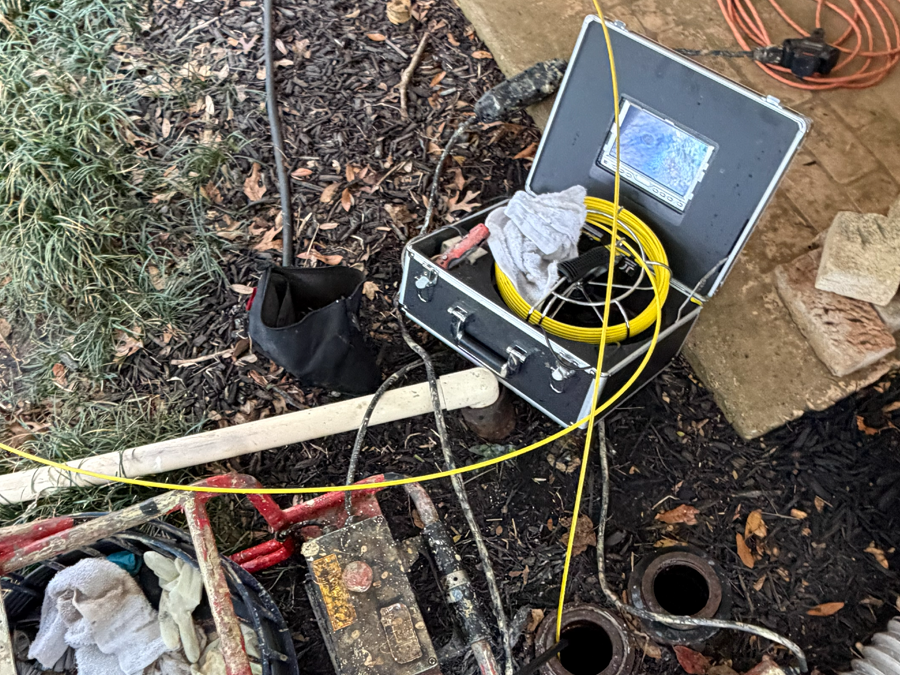
If your home was built before 1985, the smartest, lowest-cost step is a video sewer camera inspection. A waterproof camera goes through your sewer line and shows exactly what’s happening underground: pipe material, corrosion level, channel formation, cracks, scale buildup, and slope problems. This is the only way to definitively confirm what your pipes are made of – and what condition they’re in – without opening walls or excavating.
If the inspection shows your cast iron is failing, you have two main paths:
Traditional excavation and replacement. Dig up the slab, replace the pipe with PVC, repair the slab and any landscaping. Typically takes 3–6 weeks and runs significantly more expensive.
Trenchless cast iron pipe lining. A new structural liner is installed inside your existing pipe – no excavation, no slab work, no landscaping damage. Most jobs complete in 3 to 5 days, with a 50-year transferable warranty on the lined pipe.
For older DFW homes, cast iron pipe lining is almost always the better choice. It avoids the worst part of slab-foundation pipe repair, and the new liner is sealed against further corrosion and joint failure. It’s also why trenchless sewer repair in Dallas has largely become the default approach for pre-1980 homes.
Frequently Asked Questions
How can I tell if my home has cast iron pipes without opening walls?
The fastest non-invasive method is to check any exposed sections of pipe – usually at outdoor cleanouts (visible PVC means at least the outer portion is plastic), in the garage where drain lines may emerge, or under sinks where traps connect to the drain stack. Cast iron is dull gray or black, heavy, and may show rust. PVC is white or off-white plastic; ABS is black plastic. But the only definitive way to know what’s running under your slab is a video sewer camera inspection – it takes about an hour and shows the entire line.
Does my home’s age matter more than my neighborhood?
Yes. Neighborhoods give a probability indicator (lots of older homes = higher likelihood of cast iron), but the year your specific home was built is the real signal. A 1988 home in Lakewood almost certainly has PVC; a 1955 home in Plano almost certainly has cast iron.
My pipes have lasted this long – why would they fail now?
Cast iron corrosion accelerates as the protective scale on the inside of the pipe breaks down. Once wall thickness drops below a certain point, failure modes (cracks, channel formation, collapsed sections) compound quickly. Many pipes that “still work” are actually in late-stage failure.
Does this affect property value?
Yes. Older cast iron pipes can affect home appraisals and insurance, and some buyers will negotiate against the cost of expected pipe replacement. Documented cast iron pipe lining with a 50-year transferable warranty actually adds resale value – it removes the buyer’s concern entirely and gives them documented proof of the work. For a fuller look at the economics, see our analysis of whether trenchless sewer repair is worth it.
How disruptive is trenchless repair?
Minimal. We access the pipe through one or two existing cleanouts (no excavation required), and most jobs are completed in 3 to 5 days. You stay in the house.
How much does cast iron pipe lining cost in Dallas and Fort Worth?
Trenchless cast iron pipe lining typically runs significantly less than full excavation and replacement, but specific pricing depends on pipe length, diameter, and condition. A video camera inspection is the right first step to get accurate numbers.
Get a Definitive Answer About What’s Under Your Slab
You don’t have to wonder whether your cast iron is failing. A video camera inspection tells you exactly what’s happening underground in under an hour – and if the pipe is sound, you’ll have peace of mind. If it isn’t, you’ll have a clear path forward without the stress of an emergency.
Call 469-949-3126 or request a free estimate. We serve homeowners across the Dallas–Fort Worth Metroplex with no-dig sewer line repair in Fort Worth, Dallas, and the surrounding suburbs – 3 to 5 days, 50-year transferable warranty, no slab work required.
A great way to reach us!